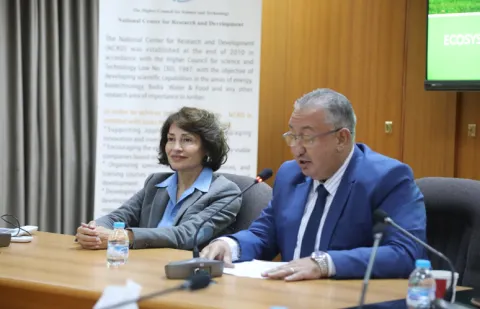
The National Center for Research and Development (NCRD) last week convened a policy dialogue titled “Agroforestry between Governance and Climate Policies,” bringing together local and international experts and stakeholders from the agriculture and environment sectors to discuss climate-related challenges. The session focused in particular on the agroforestry project implemented by NCRD in partnership with Friends of Nature -Lebanon.
Participants underscored the importance of prioritizing climate-related issues, including policy development and governance frameworks, to create an enabling environment for adopting agroforestry within ecosystem-based adaptation and national food production systems.
NCRD President Dr. Mohammad Ali Wedian highlighted the importance of strengthening national efforts toward climate-smart agriculture, sustainable water management, and biodiversity conservation.
Dr. Wedian called for continued dialogue and integrated efforts among government institutions, international organizations, and local communities to achieve a more sustainable future for agriculture in the region. He also stressed the need to mainstream agroforestry practices into national plans, including the National Adaptation Plan, the Water Strategy, and the Climate-Smart Agriculture Plan.
Dr. Myrna Samman, President of Friends of Nature - Lebanon, delivered a comprehensive presentation on the concept of agroforestry, its applications, and its role in enhancing food security and improving ecosystem efficiency.
Dr. Samman explained that agroforestry systems significantly contribute to productivity and sustainability by increasing tree yields, improving crop returns, enhancing labor efficiency, and maintaining soil fertility. She emphasized the need to tailor agroforestry techniques to the needs of local farmers to ensure long-term success.
The project, titled “Enhancing Ecosystem-Based Agricultural Resilience in the Levant through Agroforestry,” is implemented in cooperation with Friends of Nature- Lebanon and supported by the International Union for Conservation of Nature’s Global Ecosystem-based Adaptation Programme (IUCN). It is a regional initiative implemented in Jordan, Lebanon, and Syria, aiming to strengthen the resilience and sustainability of agricultural and food production systems in the face of climate change through ecosystem-based agroforestry approaches.
Related News


Related News