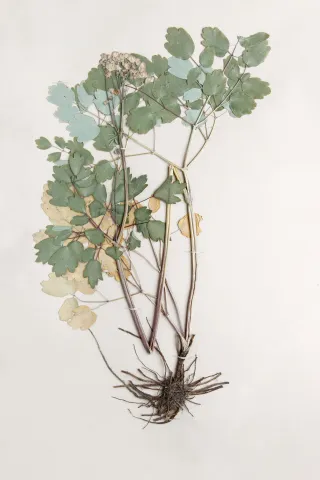
Herbarium Concept and Origin: Al-Safawi Herbarium is one of the main outcomes of the vegetation study project conducted in the North-Eastern Badia region. This project was implemented by the Jordanian Badia Research Program in cooperation with British partners and the University of Jordan between 1992 and 1994.
The herbarium was established to preserve and document medicinal, aromatic, and wild plants found in the North-Eastern Badia region and the border areas with Iraq and Syria within the Levant region, including Jordan. This has been achieved through collecting plant genetic resources, scientifically classifying them, and preserving them in a plant herbarium at the Al-Safawi Field Station.
Plant Collections
Approximately 445 plant specimens (genetic resources) were collected during the original project period (1992–1994). Of these, around 270 plant specimens preserved at the Al-Safawi Herbarium were studied and scientifically classified. The remaining specimens collected as part of the project’s activities related to medicinal, aromatic, and wild plants are housed at Kew Gardens in the United Kingdom.
Currently, the herbarium contains more than 270 plant specimens representing the ecological diversity of the flora of the Jordanian Badia.
Modernization and Development (2025–2026)
In 2025, the National Center for Research and Development (NCRD), in cooperation with the Royal Botanic Garden (RBG), conducted high-resolution scanning of the plant specimens preserved at the herbarium as well as those housed at Kew Gardens.
The purpose of digitizing the specimens is to provide visual and scientific material accessible through QR codes, enabling users to identify:
- The scientific name of the plant.
- The common name in both Arabic and English.
- The collection site.
- The collection date.
- Relevant scientific information.
Work is currently underway to activate a unique identification code for each plant specimen. The herbarium is also being developed on the NCRD website and will be electronically linked with the Royal Botanic Garden database to facilitate access to scientific information through QR code scanning.